Types of Explainer Videos: 7 Styles, Costs and Who Each Suits
You've decided it's time for an explainer video. Then you start looking, and the words fly at you: whiteboard, motion graphics, 3D, kinetic typography. It reads like a menu in a language you never learned.
That's a real worry, because the wrong pick costs money. Choose badly and your plumbing company ends up looking like a phone app.
The good news is that the types of explainer videos are mostly just different looks. Each look suits some businesses and fights others, and the price depends far more on who makes the video than on the look itself.
This guide walks you through the 7 main styles in plain words, a price table for 2026, a style pick for 10 kinds of local business, and 5 steps to choose without wasting money.
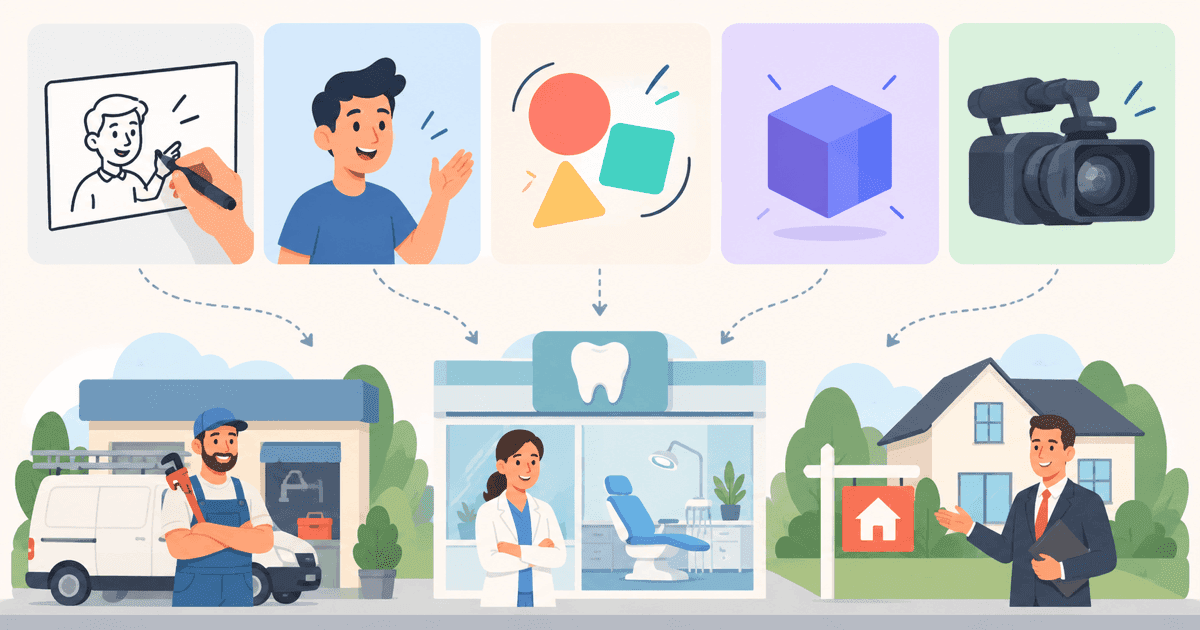
The main types of explainer videos are whiteboard, 2D animated, motion graphics, 3D, live action, screencast and kinetic typography. Most local service businesses do well with 2D animation or whiteboard, because both show a problem and a fix clearly. What you pay depends mostly on who makes it, not the look.
Key takeaways
- Start with 2D animation for most service businesses, or whiteboard if you need to teach a process.
- The same style can cost under $300 or over $15,000. Who makes it drives the price.
- Match the length to where the video runs: 30 to 60 seconds for ads, 60 to 90 for your homepage.
- A clear script beats a fancy style every time.
- Mixing a 2D story with a short real clip of the owner is often the best value.
What are the main types of explainer videos?
There are seven styles you'll hear about most. For each one, here's what you see on screen, who it fits, and the catch.
Whiteboard animation
A hand draws simple pictures on a white page while a voice talks. Each drawing appears right as the words explain it, so it feels like a good teacher at a whiteboard.
Pexo's guide to explainer video types calls it the budget-friendly choice for step-by-step teaching. That makes it a strong fit for anyone whose customers need a process explained in order: accountants, lawyers, tax preparers and financial planners.
- What a 30-second version looks like: a law firm sketches "what happens after a car accident claim" in four drawings.
- The catch: it can feel plain in a fast social ad.
Our whiteboard animation video guide goes deeper on this style. If you want one made for you, our whiteboard videos start at $197 for 30 seconds, delivered in 7 days.
2D animated
Flat, drawn characters and scenes act out a short story. Picture a cartoon homeowner who finds a leak, calls you, and relaxes.
This is the style to start most service businesses with. It's friendly and easy to match to your brand colors. It can also show a problem the viewer can't see, like water behind a wall or a tree root in a sewer line.
- Good for: plumbers, roofers, HVAC companies, cleaners and dentists.
- What a 30-second version looks like: "Hear water when every tap is off?" A cartoon wall opens up, your van arrives the same day, and the video ends on your phone number.
- The catch: stock characters can look like everyone else's.
Motion graphics
Here, shapes, icons, words and charts move instead of characters. The ideas themselves do the moving.
It suits businesses that sell something you can't picture, like insurance agents, financial advisors, IT support and software companies. An HVAC shop can use it too, to explain a maintenance plan with three icons: price, visits and discount.
The downside is warmth. In a trade where people buy the person, it can feel a little cold.
Not sure where motion graphics ends and animation begins? This guide on motion graphics vs animation sorts it out.
3D animation
Objects get depth, light and shadow, as if you could pick them up. It suits anyone who needs to show how a physical thing works, like a dentist showing how an implant sits in the jaw, or a company that makes a product or a machine.
It isn't cheap, though. Vidico puts 60-second 3D animation at $5,000 to $25,000 or more, and premium 3D work easily runs above $10,000.
Most service businesses don't need 3D. Our 2D vs 3D explainer video comparison shows where the extra money goes.
Live action
Real people, real places, and a camera. Pexo points it at service businesses, testimonials and founder-led brands, and nothing beats a real face when trust is the whole point.
It suits a surgeon, a high-end contractor, a family restaurant or a gym owner. Real food and real haircuts also look better on camera than in a cartoon.
The catch is cost, and you'll see the real numbers below.
Screencast
A recording of a computer or phone screen, with a voice walking through the clicks. It suits any business with an online booking system, customer portal or app.
Picture a gym showing members how to book a class in 20 seconds. The catch is that it shows a screen, not a problem, so it rarely works as an ad.
Kinetic typography
The words themselves move on screen, in time with the voice. It suits a short, punchy message, like a restaurant's new catering menu or a cleaner's spring offer on social media.
There are no pictures of your work, so the script has to carry everything.
Other styles you may hear about
Big style lists run to 12 or 20 types. Most of the extras are variations on the seven above:
- Isometric: a 2D look drawn at an angle so it feels a bit 3D, often used for buildings and tech.
- 2.5D: flat art with some depth and camera movement added.
- Cutout and collage: paper-like shapes and photos moved around the screen.
- Stop motion: real objects moved frame by frame. Charming, but slow and costly.
- Mixed media: animation and real footage in one video. More on that below.
The 7 styles side by side
| Style | What you see | Good fit for | Where it works best | Watch out for |
|---|---|---|---|---|
| Whiteboard animation | A hand drawing simple pictures as the voice talks | Accountants, lawyers, tax preparers, anyone explaining steps | Service pages, email follow-ups | Can feel plain in a fast ad |
| 2D animated | Flat cartoon characters acting out a story | Plumbers, roofers, HVAC, cleaners, dentists | Homepage and paid ads | Stock characters look generic |
| Motion graphics | Moving shapes, icons, words and charts | Insurance, financial advice, IT, software | Pricing and plan pages | Can feel cold for people-first trades |
| 3D animation | Objects with depth you can turn and look inside | Dental procedures, products, machines | Product and procedure pages | 3D runs $5,000 to $25,000+ for 60 seconds |
| Live action | Real people and places on camera | Surgeons, high-end contractors, restaurants, gyms | About page, social media | Full shoots get expensive fast |
| Screencast | A recorded screen with a voice guiding you | Online booking, customer portals, apps | Help pages, welcome emails | Shows a screen, not a problem |
| Kinetic typography | Words moving in time with the voice | Short offers and social clips | Social posts and Reels | No pictures, so the script must be sharp |
Can you mix them? Yes, and plenty of good videos do. A 2D story with a short real clip of the owner at the end is a strong pair. The animation explains, and the real clip proves you exist.
Pro tip: if you film the real clip yourself, keep it to 3 to 5 seconds. A phone held sideways in good daylight is plenty for "Hi, I'm Dana, and we'll be there today."
Need an explainer video? Get a 30-second explainer for $297 → We write the script, record the voiceover and animate it, delivered in 7 days.
What does each type of explainer video cost?
Here's the surprise: the style is only part of the price. The bigger part is who makes it.
You can see that in how far apart the price guides sit. Two studios looked at the same styles for a 60-second video and came up with very different ranges:
| Style (60 seconds) | Vidico's range | Yum Yum Videos' range |
|---|---|---|
| Whiteboard animation | $1,500 to $5,000 | $3,000 to $15,000 |
| Motion graphics | $1,500 to $6,000 | $5,000 to $20,000 |
| 2D animation | $2,500 to $10,000 | $8,000 to $25,000 |
| 3D animation | $5,000 to $25,000+ | $10,000 to $100,000+ |
| Live action | $5,000 to $20,000+ | $10,000 to $100,000+ |
Same styles, prices that differ by thousands. That gap comes from the maker: their location, their team size and how much custom art they draw.
So think in routes, not styles. There are five: DIY software, an AI-assisted studio, a fixed-price package, a custom studio, and a live-action shoot.
DIY software
DIY software is a tool where you pick a template and type in your own words. It's the cheapest route, and some tools start around $99. Yum Yum Videos puts AI tools and DIY templates at $0 to $500.
But you do all the work. You write the script, record the voice (or use a robot one), and drag stock pieces into a timeline. It often uses the same characters thousands of other companies use.
Time has a cost too. Say your time is worth $50 an hour and the video takes you 10 hours. That "free" or $99 video has already cost you $500 or more.
AI-assisted studio
AI-assisted studio services use artificial intelligence, software that can write, speak or edit a bit like a person, to speed things up. A person still checks the final cut.
Creamy Animation says AI-assisted studio videos typically start around $1,500 to $4,000. That's a real jump from DIY.
Fixed-price done-for-you package
Fixed-price packages are a set price for a set product. You get a script, a real human voiceover and animation, delivered in a set number of days.
You know the cost before you start, and a person does the work for you. This sits right in the gap between "cheap but it's all on you" and $1,500-plus.
Custom studio animation
Custom studio animation is built from scratch for your brand, with an original art style, your own characters and a longer runtime if you need it. It costs more and takes longer.
In a July 2026 study, Yum Yum Videos got 61 usable quotes for a 60-second custom video. They ranged from $2,800 to $27,000, with a median of $9,680 and a median timeline of 7 weeks.
Live-action shoot
Live action means a camera crew filming real people, products or your real shop. A big shoot with actors, locations and crew is the most expensive route by far.
Here's how the five routes compare.
| Type | Typical Price | What's Included | Best For |
|---|---|---|---|
| DIY software | $0 to $500, many tools from $99, plus your hours | Template visuals, your own script and edits, often no human voiceover | Businesses with time to spare and no budget |
| AI-assisted studio | $1,500 - $4,000 | Script help, AI or hybrid voice, faster turnaround | Businesses that want speed over a fully custom look |
| Fixed-price done-for-you package | One flat, all-inclusive price (ours: $297 for 30 seconds) | Written script, human voiceover, animation, set delivery day, revision rounds | Most small businesses that want a real video without agency pricing |
| Custom studio animation | $5,000 - $15,000 for 60 seconds | Original art style, brand-specific characters, longer runtime | Businesses that need a video that looks nothing like anyone else's |
| Full live-action production | $50,000 - $250,000 for an average 30-second video, once a shoot goes past a basic home-studio setup to actors, locations and crew | Camera crew, real people, real locations | Big brand campaigns. For a small business, a short real clip inside an animated video is the usual fit |
Where do those big numbers come from? Yans Media says an average 30-second live-action video can cost anywhere from $50,000 to $250,000. That's for a shoot with actors, locations and a crew, not the price of filming yourself in your own shop.
For animation, Vidico says a 60-second custom explainer from a studio typically costs $5,000 to $15,000, depending on complexity and style. And one industry survey of 45 agencies found the average 30-second explainer costs £2,960 in 2026.
That's a wide, hard-to-predict range. So here's what we charge, plainly:
- 2D explainer: $297 for 30 seconds (normally $497), or $497 for 60 seconds.
- Whiteboard: $197 for 30 seconds, or $397 for 60 seconds.
- Both include: a script, a human voice, animation, delivery in 7 days, 3 revision rounds and a money-back guarantee.
- Custom and premium projects: from $1,299, planned with you on a free call so you know the full price first.
What do you get from our fixed-price package compared to a $5,000 studio video?
A fixed-price 30-second video gets you a full script, a real human voice, full animation, delivery in 7 days, 3 rounds of revisions and a money-back guarantee. A $5,000-plus custom studio video adds an original art style built just for your brand, your own characters and more room for a longer runtime.
Think of it like buying a suit. A fixed-price video is a well-made suit off the rack: it fits, it looks sharp, and it does the job. A $5,000 custom video is cut to your exact measurements, in fabric nobody else has.
Both keep you covered. One costs a lot more, for a difference most of your customers will never notice.
What if 30 seconds isn't enough? The 60-second package gives you about double the runtime. That's room to walk through a process, or answer a worry, before your call to action.
Which type of explainer video fits your business?
It depends on what you sell, and on how much a customer needs to trust you before they buy. Here's a simple map for 10 kinds of business, with the style to start with.
| Business Type | Recommended Type | Style to start with | What the 30-second video shows | Why |
|---|---|---|---|---|
| Plumber, roofer | 30-second animated | 2D animated | A slow leak behind a wall, or water getting in under the shingles | Direct problem-and-solution message for a homepage or paid ad |
| HVAC | 30-second animated | 2D animated or motion graphics | A cartoon family sweating in July, then a tune-up plan in 3 icons | Shows a problem, then sells a maintenance plan |
| House or office cleaner | 30-second animated | 2D animated or kinetic typography | A "what's in a deep clean" checklist ticking off on screen | Makes an invisible service easy to picture |
| Dentist, chiropractor | 30 to 60-second animated | 2D animated, or 3D for a procedure | "What happens at your first visit," step by step | Calms nerves before a first visit |
| Salon, med spa | Custom studio (fixed-price works fine to start) | Live clips of real results, or a screencast of online booking | Real hair or skin results, then "book in 3 taps" | People buy the result they can see |
| Gym, coach | 60-second animated (custom if brand-heavy) | 2D animated with a short real clip | How the intro offer works, then the owner saying hello | Needs a bit more story to explain a service or a lifestyle |
| Restaurant | 30-second social clip | Kinetic typography or motion graphics | A new catering menu or how online ordering works | Real food footage beats cartoon food |
| Realtor | 60-second animated | 2D animated or whiteboard, with a short real intro | "How selling your home with me works: 5 steps" | Builds trust before a big decision |
| Law firm | 60-second animated | Whiteboard | "What happens after a car accident claim" | Explains a process with no actors and no client privacy issues |
| Retail shop, small SaaS founder | 60-second animated, upgrade to custom later | Screencast, motion graphics or 3D for a product | How to order and pick up in store, or one key feature | Needs to explain a feature clearly first, polish the brand later |
A dentist sells calm, so a 30 to 60-second video that walks through a visit removes fear. A plumber or roofer is usually solving an urgent problem, so a direct 30-second video that names the problem and the fix works best.
A realtor, coach or gym owner sells more of an experience. A 60-second video gives enough room to build interest before asking for the click.
Two 30-second scripts you can borrow
At about 2.5 spoken words per second, a 30-second script tops out near 75 words, and 50 to 60 leaves room for pictures. Here's what that looks like for two trades.
Plumber (2D animated): "Hear water running when every tap is off? That could be a leak behind your wall, and it gets worse every day. We find it without tearing up your house, and we fix it the same day. Flat price, no surprises. Call [Business] now at [phone number]."
Law firm (whiteboard): "Hurt in a car accident? Here's what happens next. First, we look at your case for free. Then we deal with the insurance company, so you don't have to. You focus on getting better. Call [Firm] today at [phone number]."
Pro tip: read your script out loud with a timer. If you can't finish it calmly in 30 seconds, cut a sentence rather than talking faster.
How do you pick the right type without wasting money?
You can choose in about 10 minutes. Work through these five short questions, in order.
Step 1: Write down where the video will run
Decide if the video's main home is your homepage, a paid ad, or your sales calls. Where it lives changes how long it should be.
Step 2: Pick a length that matches that use
Yum Yum Videos says 30 to 60 seconds suits ads and awareness, and 60 to 90 seconds suits homepage explainers and service introductions. Most marketers agree: 71% say 30 to 60 seconds is the most effective length.
Need to stop someone scrolling? Go short. Already on your homepage? You have more room.
Step 3: Decide on a style and a look
Pick the style from the tables above that fits your trade. Then ask whether a proven template look would hurt your brand, or look normal for your industry.
Most service businesses (plumbers, dentists, gyms) do fine with a template style. Brands built on a distinct look often need custom work.
Step 4: Match your answer to one of the 5 budget tiers above
Once you know your length and your look, the price table points you to a route: DIY, AI-assisted, fixed-price package, custom studio or live action.
Step 5: Get a fixed price before you commit anything
Never start a video on a vague quote or an hourly rate. Ask for one number, in writing, before any work begins.
Want something bigger? Book a free 30-minute video call → We plan your custom video with you and send a fixed quote within 24 hours.
Where should your explainer video run?
The style you pick should suit the spot where people will watch it. Shopify's roundup of video stats notes that homepages, video galleries and product pages get the highest play rates on company websites. So for most local businesses, the homepage is the first place to put it.
Short also wins with viewers. The same Shopify page reports that 63% of consumers would most like a short video to learn about a product or service.
Here's how one video can work in three places:
- Homepage: the full 60-second version, near the top of the page.
- Facebook or Instagram ad: a 30-second cut that opens on the problem.
- Google Business Profile: the 30-second cut, so people who find you on the map see it too.
Pro tip: add captions. Many people scroll with the sound off, and a video without captions loses them in the first few seconds.
When does live action beat animation for a small business?
Live action wins when customers need to see your real face, shop or product to trust you. For most small businesses, though, animation is the better default on price and clarity.
It also helps you stand out. Vidico reports that only 23% of marketers make animated videos, compared with 51% making live action. If every competitor posts shaky phone clips, a clean animated video looks different.
At those shoot prices, here's how to use live action instead: for one moment, not the whole video. A short real intro from the owner, or a quick clip of the crew at work. The explaining part, especially anything with steps, is usually clearer in animation anyway.
Pexo calls 2D motion graphics the all-round style, with whiteboard the budget pick. Between them, they cover most of what a plumber, dentist, gym or realtor needs to say.
Save full live action for the rare case where customers buy trust in one person, like a surgeon or a high-end contractor. Even then, a short clip mixed into an animated video often does the job. Our guide on when to film live action covers that call in more detail.
What a style is, and what it is not
No style fixes a muddled message. A beautiful 3D video with a vague script still loses the viewer, while a plain whiteboard video with a clear script can win.
So the script matters more than the look. Quality still counts, since 87% of consumers say video quality affects their trust in a brand. But "quality" means clear sound, a clean look and a message that makes sense, not the most expensive style.
And a DIY tool is the right call sometimes. If you have more time than money, and you're happy with a template look, start there. Just count your hours honestly.
Example: a roofing company picks a type and length
Say you run a roofing company and want more calls from your homepage. Here's how the five steps play out.
- Where it runs: the homepage, plus Facebook ads during storm season.
- Length: storm ads must grab attention fast, so you pick 30 seconds over 60.
- Style: roofing customers want a fast fix and a fair price, not a custom art style. A 2D animated template look is fine, and it can show water getting in under the shingles, which a camera can't.
- Budget tier: that lands you on the fixed-price package.
- Price: a written quote confirms the fixed price, with no surprises.
The script follows the same four parts most good explainers use: hook, problem, solution, call to action.
- Hook: it opens on a leaking ceiling.
- Problem: it names what a delayed repair costs the homeowner.
- Solution: it shows your same-day inspection.
- Call to action: call now for a free quote.
At 30 seconds, the script runs short and tight. A full 60-second script needs roughly 140 to 150 words, because finished video runs about 150 spoken words per minute.
Frequently asked questions
Do I need a different video type for Instagram ads versus my homepage?
Not a different type, but often a different length. A 30-second animated video works well for both, since 30 to 60 seconds suits awareness campaigns and ads, while 60 to 90 seconds suits homepage explainers. Many small businesses trim a 60-second video for ads, or start with the 30-second package for both.
Can I upgrade from a fixed-price video to a custom one later?
Yes. Plenty of businesses start with a fixed-price 30 or 60-second video to test their message, then move to a custom studio project once they know what works. There's no penalty for starting small.
Is a whiteboard-style video cheaper than a 2D animated one at the same studio?
Usually, but not by as much as you'd think. Whiteboard animation and 2D motion graphics are both common explainer styles, and Vidico prices 60-second whiteboard at $1,500 to $5,000 against $2,500 to $10,000 for 2D. Ours are $197 for 30 seconds of whiteboard and $297 for 2D.
What's the difference between motion graphics and 2D animation?
Motion graphics move shapes, icons, words and charts. 2D animation tells a story with drawn characters and scenes. Motion graphics suit ideas and numbers, like a pricing plan, while 2D animation suits people and problems, like a homeowner with a leak.
What happens if I pick the wrong type for my business?
Usually you end up with a video that doesn't match where you use it, like a slow, story-heavy video in a fast-scrolling ad slot. That's fixable, not fatal. Re-cut it shorter, change the script, or move it to a different spot on your site.
Do I need to write the script myself, or is that included?
With a fixed-price done-for-you package, the script is written for you as part of the price. You don't need marketing or writing skills. You review a draft and ask for changes, instead of starting from a blank page.
Ready to pick your style?
Here's one question to ask yourself tonight. If a customer watched 30 seconds about your business, what would they need to see to call you?
Your answer tells you which style to pick. A hidden problem points to 2D animation, a process points to whiteboard, and a face people must trust points to a short real clip. We've made over 16,000 videos for more than 13,500 businesses since 2012, and most of them started with that same question.
Ready to get your own video made? Order a 30-second explainer for $297 and have it in 7 days, or book a free call if you want a custom video from $1,299.
Related Reading
- 2D vs 3D Explainer Videos: The Real Cost Difference: Not sure which style fits your budget and timeline? This 2D vs 3D explainer…
- Explainer Videos from $297 →: Professional animated explainer videos delivered in 7 days.
Want a custom video made for your business?
Book a free 30-minute call. We plan your video with you and send a fixed quote within 24 hours. Custom videos from $1,299.
Book a Free Video Call →