Animation vs Live Action Video: Honest Pros, Cons and Costs
You have money for one video, and two ways to spend it. Pick animation when the thing you sell is hard to see, changes often, or has to be ready fast. Pick live action when customers are buying a person, a place or a result they can see.
The animation vs live action choice sets what you pay, how fast you get it, and how long the video stays useful. This guide gives you sourced 2026 prices, honest pros and cons, and a six-question scorecard.
For most plumbers, roofers, lawyers and accountants, animation is the better buy. It costs less, needs no shoot day and is cheap to change later. For restaurants, gyms, salons and personal brands, live action usually wins, because the product looks good on camera.
Key takeaways
- A basic animated explainer usually costs less than a basic filmed ad from the same studio.
- Live action is better at proving you are real.
- The biggest hidden cost is change: a new logo or a new team can mean a reshoot.
- Filming patients or clients needs written permission. Animation avoids that problem.
- Dentists and med spas often do best with both: a short filmed hello and an animated explanation.
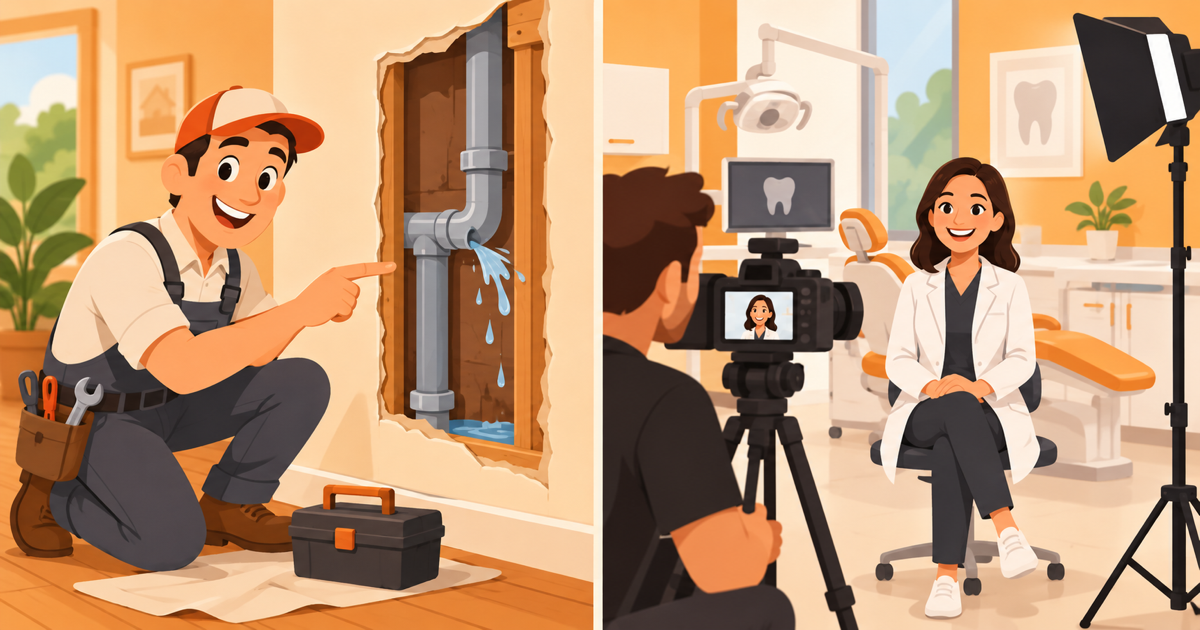
Animation vs live action at a glance
Side by side, the two styles differ most on price, on what they can show, and on what a change costs later. The table below compares them on the points a small business owner asks about first.
An animated video is a video made from drawings, shapes or 3D models that move, usually with a voiceover. A live action video is a video shot with a real camera, showing real people, places or products.
| Animation | Live action | |
|---|---|---|
| Basic studio price | $2,000 to $4,500 for a simple 30 to 60 second explainer | $5,000 to $10,000 for a 15 to 30 second commercial |
| Time to finish | Desk work only, so dates are easy to predict | Needs people, a place and good light on the same day |
| What it can show | Anything you can describe: inside a pipe, a tooth, a legal process | Only what exists and what a camera can reach |
| Updating later | Change a frame or re-record one line | Often a new shoot day |
| Who has to be on camera | Nobody | You, your staff or paid actors |
| Best for | Hidden services, small budgets, tight deadlines | Faces, food, rooms, finished jobs, testimonials |
Both price rows come from the same Yans Media price list, so they compare like with like.
Live action is still the more common pick. According to Wyzowl's 2026 survey, reported by HubSpot, 51% of companies made live-action video, 23% made animated video and 19% made screen recordings.
Need an explainer video? Get a 30-second explainer for $297 → We write the script, record the voiceover and animate it, delivered in 7 days.
What are the pros and cons of an animated video?
An animated video can show things a camera can't reach, costs little to change, and needs nobody on camera. Its main weakness is that it shows no real faces. That can feel less personal when people are buying the person.
The pros
- Shows the hidden part. A leak behind drywall, a crown going on a tooth, or the steps of an injury claim.
- No shoot day. Nothing depends on the weather, a crew or your staff being free.
- Easy to change. A new service usually means editing a few frames, not starting over.
- Nobody has to be on camera. Good news if you or your team hate being filmed.
- Privacy comes built in. There is no real patient or client on screen.
The cons
- No real face. People choosing a surgeon or a divorce lawyer often want to see who they will meet.
- Cheap templates look cheap. A stock character in a stock office could be anyone's business.
- The style can feel childish. A goofy cartoon can fall flat on a serious topic like a lawsuit or a diagnosis.
- It can't prove a result. A drawing of a clean driveway is not the same as footage of yours.
Prices from one maker to the next vary a lot. When Yans Media sent the same brief to 152 explainer companies, the 110 quotes ran from $950 to $250,000. The average was $8,746.
Pro tip: ask to see three finished videos for businesses like yours before you pay. If every sample uses the same characters, yours probably will too.
What are the pros and cons of a live action video?
A live action video's biggest strength is proof: real people, rooms and results that a viewer trusts at a glance. Its main weaknesses are cost, shoot days that can fall through, and footage that ages as your business changes.
The pros
- Shows you. A real owner saying hello does something no drawing can.
- Proves results. A finished kitchen, a packed gym class or a plate of food sells itself.
- Suits testimonials. Real customers talking about real jobs are hard to fake. Wistia's 2026 State of Video report found 47% of companies planned to make testimonial videos, up from 17% in 2023.
- Can cost very little. If you film it yourself on a phone, the main cost is your time.
The cons
- More people to pay. A crew shoot is a group effort. As Pixune puts it, "even small professional productions often require 15 to 20 people on set."
- Shoot days fall through. Rain, a sick staff member or a busy Saturday can push the whole thing back.
- Reshoots cost real money. Bad sound or a fluffed line can mean paying for another day.
- Footage ages. People leave, logos change and rooms get repainted.
- You need permission. Anyone you can recognize on camera should sign a release form, which is a short permission note.
Permission matters most in health care. Under the HIPAA privacy rule, a dental or medical office usually needs a patient's written authorization before using their health information in marketing. That covers a patient telling their treatment story on camera.
Quality also shows more on camera. According to Wyzowl's State of Video Marketing report, via Vidico, 87% of consumers say video quality affects how much they trust a brand. A shaky clip with echo can cost you trust instead of earning it.
How much does each one cost a small business in 2026?
A professional 60-second animated explainer usually costs $2,500 to $15,000, depending on style. A basic filmed short ad usually costs $5,000 to $10,000, and a full two-minute shoot can pass $100,000.
| Option | Typical price | Source |
|---|---|---|
| AI tools and DIY templates | $0 to $500 | Yum Yum Videos, 2026 |
| Studio animated explainer, 60 seconds | $2,500 to $15,000, depending on style | Vidico, 2026 |
| Simple animated explainer, 30 to 60 seconds (basic) | $2,000 to $4,500 | Yans Media |
| Live action social video, 1 to 2 minutes (basic) | $1,000 to $3,000 | Yans Media |
| Live action short commercial, 15 to 30 seconds (basic) | $5,000 to $10,000 | Yans Media |
| Professional animated video, 2 minutes | $15,000 to $35,000 | Pixune, updated 2026 |
| Professional live action video, 2 minutes | $17,000 to more than $100,000 | Pixune, updated 2026 |
Look at the same length from the same studio and animation usually comes out cheaper. The one exception is a short, simple filmed social clip, which can cost less than a custom animation.
Where does the live action money go?
Most of a live action budget goes on people and places. Demo Duck's cost breakdown lists a director at $3,000 to $6,000 and a sound engineer at $500 to $1,000 a day. A location runs $500 to $5,000, and actors $500 to $3,500. The page is not dated, so treat those as a rough guide.
Animation skips the location and the crew. You still pay for a script, a voice and the animator's time.
What do small businesses actually spend?
Most small businesses spend far less than the studio ranges above. Wistia's 2026 report found almost 40% of companies spent under $5,000 on video in the past year.
For comparison, our 30-second animated explainer is $297. We write the script, record a human voiceover and animate it. You get 3 revision rounds, delivery in 7 days and a money-back guarantee.
Which costs show up after the video is finished?
The cost that surprises most owners is the cost of change. Filmed footage often needs a new shoot day when your team, van or office changes. An animated video can usually be fixed by editing a few frames.
Say you run a dental office with five staff. In January you film a team video in the waiting room. By December, one hygienist has left, you have a new logo, and the room is a new color.
Now the video shows a person who no longer works there, under a sign that no longer exists. Fixing it means a new shoot day. If the same video were animated, you would swap one character and one logo and keep the rest.
Here are the hidden costs to plan for on each side:
- Live action: a second shoot day, new release forms, music licenses, and editing time for each new version.
- Animation: extra revision rounds past what is included, new voice lines when details change, and new sizes for each ad platform.
- Both: captions, a short cut for ads, and your own time to review drafts.
Ask for the project files or raw footage at delivery, too. Without them, even a small fix can mean starting from scratch.
Which one should a plumber, a dentist or a lawyer pay for?
Plumbers and lawyers usually get more from animation, because what they sell is hidden from view. Dentists often do best with both: animation for the treatment and a short filmed hello for the team.
- Plumber: the problem sits inside walls, so an animated cutaway does the explaining.
- Dentist: nobody wants a close-up of a drill, but patients do want to see who they will meet.
- Law firm: you can't film clients, and legal steps are invisible. Lawyer ads also have their own rules, set by each state bar, so check yours first.
Pexo's 2026 guide to explainer styles backs up the face point. It says that when trust is the barrier, a human face on screen does what no illustration can, and it names clinics among the businesses that gain most. It also says whiteboard animation is for teaching step-by-step processes.
Pro tip: open with the question your customer already asks. A plumber's animated video might start, "See a water stain on your ceiling? Here is what is going on behind it, and how we fix it without tearing up the whole room."
For a table covering trades, clinics, law firms, software and restaurants, see our guide to illustrated vs filmed video for each kind of business.
Want something bigger? Book a free 30-minute video call → We plan your custom video with you and send a fixed quote within 24 hours.
Which one fits the job your video has to do?
The job your video has to do matters as much as your trade. Explaining a process or a price usually favors animation, while proving you are real or showing a result usually favors live action.
| Job | Better pick | Good length |
|---|---|---|
| Paid ad or awareness video | Either, if the first seconds grab attention | 30 to 60 seconds |
| Homepage "what we do" video | Animation | 60 to 90 seconds |
| Introduce a service or product | Animation | 60 to 90 seconds |
| Answer a question customers ask every day | Animation | 30 to 60 seconds |
| Customer testimonial | Live action | Short, one story |
| Show your shop, office or team | Live action | Short, one walk-through |
The lengths come from Yum Yum Videos' 2026 length guide. It puts paid campaigns and awareness at 30 to 60 seconds, and homepage explainers and service introductions at 60 to 90 seconds.
Where the video sits matters too. The wrong video on the wrong page can cost you sales. Foundry CRO's 2026 benchmarks found landing-page video results ranging from a 10% drop to a 100% lift, depending on the video and where it was placed.
Can you mix the two?
Yes. The simplest mix is a short filmed hello from you, then an animated middle that explains the service. If you film the hello yourself, you only pay for the animation.
Our guide to shooting a live action video on a phone shows you how to film that hello in one afternoon.
How do you score your own project?
You can settle most animation vs live action decisions in about ten minutes with six yes-or-no questions. Each "yes" earns a point for animation or for live action, and the side with more points is your likely pick.
| Question | If yes, a point for |
|---|---|
| Is the thing you sell hidden (inside a wall, a body, a contract or a screen)? | Animation |
| Do you plan to rebrand, move or grow your team in the next year? | Animation |
| Do you or your team hate being on camera? | Animation |
| Do customers choose you mainly for you, the person? | Live action |
| Does your finished work look great on camera? | Live action |
| Do you have happy customers willing to sign a release and talk on video? | Live action |
A tie usually means a mix: a short filmed piece for trust and an animated piece for the explaining.
Time is the other thing to weigh. According to Wyzowl's State of Video Marketing report, via Vidico, 33% of marketers say lack of time is their top barrier to video. Another 20% say it costs too much. Animation asks less of your time, because you review drafts instead of hosting a shoot.
What should you ask a video maker before you pay?
Ask the same five questions whether you hire an animator or a film crew:
- Will I approve the script before any work starts?
- How many revision rounds are included, and what does an extra one cost?
- What is the delivery date, and what happens if you miss it?
- Do I own the finished files, including the music?
- What does it cost to change one line or one scene after delivery?
Frequently asked questions
Is animation cheaper than live action?
Animation is usually cheaper than a professional live action shoot, because there is no crew, location or actors to pay. Pixune's 2026 figures put a two-minute animated video at $15,000 to $35,000, against $17,000 to more than $100,000 for live action. A simple phone video you film yourself can cost less than either.
Do people trust animated videos less than videos of real people?
People trust a well-made video more than a poorly made one, whatever the style. A clean animated video with a warm human voice can earn trust, while a shaky filmed clip can lose it. For businesses where people buy the person, like a lawyer or a coach, a short filmed hello helps.
Can I film a live action video on my phone instead of hiring a crew?
Yes, a phone can film a good live action video if the light and sound are good. Face a window, use a cheap clip-on microphone and keep each take short. Phone video works best for a quick hello, a shop tour or a finished job.
Which lasts longer, an animated video or a filmed one?
An animated video usually stays useful longer, because nothing in it ages on its own. Filmed footage dates as soon as a team member leaves, the logo changes or the office gets a refit. Animation can also be updated one scene at a time.
Does 30 Second Productions make live action videos?
30 Second Productions' 30-second ($297) and 60-second ($497) videos are animated explainers, with a script and a human voiceover. For anything custom, book a free call. Custom videos start at $1,299.
The short version
The animation vs live action choice comes down to what your customer needs to see. Animate what hides, changes or has to be ready fast, and film faces, food, rooms and finished jobs.
Before you pay anyone, run the scorecard and ask what one change will cost after delivery.
Ready to get your own video made? Order a 30-second explainer for $297 and have it in 7 days, or book a free call if you want a custom video from $1,299.
Related Reading
- Illustrated vs Filmed Video: Which One Fits Your Business: Illustrated vs filmed video by business type: which fits a trade, clinic,…
- AI, VR and AR in Video Marketing: What's Worth Buying: AI, VR and AR in video marketing without the hype: what each one costs in…
- Explainer Video Guide: The 7 Decisions, in Order: An explainer video guide without the ebook. Make seven decisions in order,…
- Homepage Video vs No Video: What Really Changes: See what a homepage video changes on a small-business site: the first 10…
- Explainer Videos from $297 →: Professional animated explainer videos delivered in 7 days.
Want a custom video made for your business?
Book a free 30-minute call. We plan your video with you and send a fixed quote within 24 hours. Custom videos from $1,299.
Book a Free Video Call →