AI SEO for Locksmiths: Get Trusted by ChatGPT at 11pm
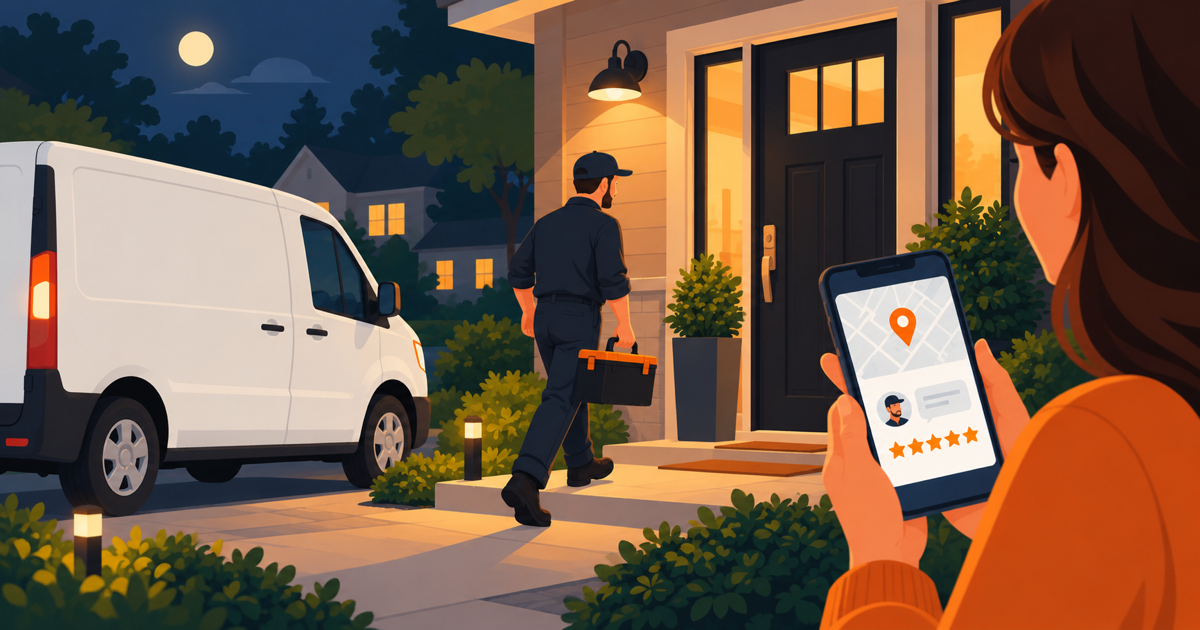
It's 11pm, the porch light is on, and someone is standing outside their own front door with no keys. They ask ChatGPT or Google for a locksmith who is open now, close by, and not a rip-off.
That last part is the hard bit for your trade. Fake listings have taught customers to be wary, and AI tools look for the same proof. That is the gap AI SEO for locksmiths closes.
AI SEO for locksmiths means giving ChatGPT, Google AI and Copilot enough proof that you are a real, local locksmith to name you. Use your legal name and one local number everywhere, show your license and honest service area, publish a clear price page, add Locksmith schema, earn recent reviews, and test often, since answers change.
Key takeaways
- Locked-out customers ask AI for speed, price and proof that a locksmith is real. Answer all three in public.
- The checks consumer agencies tell people to make are a to-do list for your website and listings.
- ChatGPT leans on Yelp and Bing more than Google, so a perfect Google profile is not enough.
- A plain price page with "from" prices answers a question many locksmiths dodge.
- Test the way your customers search: late at night, asking who is legit and who is open now.
What do people ask ChatGPT when they're locked out?
People ask ChatGPT and Google AI four kinds of locksmith questions: who can get here now, who can handle this exact lock or key, what the bill will be, and whether the business is legit. Each question needs a clear answer somewhere AI tools can read it.
Asking AI is now a normal way to find a local business. BrightLocal's 2026 Local Consumer Review Survey found that 45% of consumers used ChatGPT or other AI tools for local recommendations, up from 6% in 2025. AI tools now rank third among the places people go for a recommendation.
| Customer | What they type | What answers it |
|---|---|---|
| Homeowner locked out at night | "Locksmith near me open now with upfront prices" | True hours on every listing, a local number, a lockout page with a "from" price |
| Driver in a parking lot | "Who can make a key for a 2019 Honda CR-V tonight?" | A car key page that lists makes, key types and whether you come to the car |
| New homeowner or landlord | "How much does it cost to rekey a house?" | A rekey page with price per lock and how long it takes |
| Office manager | "Commercial locksmith for master key system in Tempe" | A commercial page naming the work (master keys, access control, panic bars) and towns |
| Anyone, before they call | "Is [your company] a legit locksmith?" | Reviews, license number, real business name, photos of your branded van |
Look at the words people add: "open now," "upfront prices," "legit." Your customers already know the trade has a scam problem, and they are asking AI to filter it out for them.
See what AI says about your business: get a free AI audit → Enter your website and we show you how AI search reads it and what to fix first.
Why do fake listings make AI SEO for locksmiths harder?
Fake listings make locksmith searches harder because customers and AI tools have both learned to look for proof that a business is real and local. A locksmith who shows that proof in public gives AI something solid to repeat.
State consumer agencies describe the problem plainly. The Wisconsin consumer protection fact sheet on hiring a locksmith warns that some companies list street addresses just to look local, and tells people to be careful if the phone is answered with a generic phrase like "locksmith services." It also warns about anyone who says up front that a lock must be drilled.
Each check a customer is told to make is something you can show online before they ever call.
| What customers are told to check | Where you prove it |
|---|---|
| A real business name, not "locksmith services" | Same legal name on your website, Google, Yelp, Bing, Apple and your van |
| A real local address, or an honest service area | Your shop address if customers visit; if not, a list of towns you serve |
| A license, where your state requires one | License number in your site footer, on your About page and in listings |
| A price before work starts | A price page with "from" prices and what changes them |
| ID on arrival, and a matching van and invoice | Photos of your branded van, uniform and team on your site and listings |
| An itemized receipt | A line on your price page: "You get an itemized receipt for every job" |
How you answer the phone matters too, because it should match what AI tools and listings say about you. Try something like this, with your own name swapped in:
"Thanks for calling Example Lock & Key, this is Sam. Are you locked out right now, or planning ahead?"
Follow Google's listing rules for locksmiths
Google makes locksmiths pass extra checks. To run Google Ads in the United States or Canada, a locksmith must first complete Advanced Verification, according to Google's Advanced Verification policy.
Local Services Ads have their own checks. Google's Local Services help on business affiliation says locksmiths may need advanced verification there too, and that every advertiser needs an affiliated, verified Google Business Profile. Google finds that profile from the business details you give, so keep them identical.
Some agencies, such as BizIQ in its 2026 locksmith SEO guide, call locksmiths a high-fraud category for Google. Whatever the label, Google's guidelines for representing your business set out the main traps:
- Address: if customers don't come to you, Google says to hide your address. A service-area business can't list a "virtual" office unless it is staffed during business hours, and P.O. boxes or remote mailboxes aren't acceptable.
- Name: no marketing taglines. "Example Lock & Key" is fine; "Example Lock & Key 24/7 Cheap Locksmith Mesa" is not.
- Phone: use a local number that you control, not a central call center line, wherever you can.
If Google asks you to verify by video, the rules are specific.
Google's video verification page says the clip must be filmed live on a phone, at least 30 seconds long and unedited. For a service-area business it suggests showing your tools and "unlocking a van that has your business branding." Google says the review can take up to 5 business days.
Pro tip: never make a second Google profile for a town where you have no real location. Duplicate profiles break Google's rules and put your real profile at risk.
Answer "how much does a locksmith cost?" before anyone calls
Wisconsin's consumer protection agency tells people to get an estimate for all work and parts before a locksmith starts. A price page that lists a "from" price for each common job, and what pushes it up, gives customers that estimate before they even pick up the phone.
"Call for a quote" leaves AI tools with nothing to repeat. A range with honest reasons is better than silence.
Here is a template you can copy. Fill in your own prices; the right numbers depend on your town and your costs.
| Service | What changes the price | Your price |
|---|---|---|
| Service call / trip fee | Distance, time of day | From $[ ] |
| House or apartment lockout | Lock type, after-hours | From $[ ] |
| Rekey | Number of locks, keys cut | $[ ] per lock |
| Car lockout | Make and model | From $[ ] |
| Car key or fob | Key type, programming, make and year | From $[ ] |
| Commercial work | Master keys, access control, hardware | Quote after site visit |
| After-hours surcharge | Nights, weekends, holidays | +$[ ] |
Under the table, add three plain lines. "We tell you the total before we start." "We open most lockouts without drilling." "You get an itemized receipt." Only write the ones that are true for you.
Then make the phone match the page. If a caller asks the price, the answer should sound like this:
"A house lockout starts at $[ ] during the day. At this hour there's a $[ ] after-hours charge. I'll confirm the total when I see the lock, before I touch it."
When the price on your page, on the phone and on Yelp all agree, a customer has no reason to keep shopping and an AI tool has a clear fact to quote.
Which reviews prove you're a real locksmith?
The reviews that prove a locksmith is real are recent ones that mention the job, the town and how fast someone showed up. A steady flow of them, with a good rating, tells customers and AI tools that real people used you and were happy.
The SOCi Local Visibility Index 2026, as summarized by BrightLocal, found that the businesses ChatGPT tends to recommend carry 4.3 stars on average. Aim for at least 20 reviews, since BrightLocal's 2026 consumer survey found 47% of people skip a business with fewer than 20. Keep them coming, too: 74% want reviews from the past three months.
The best time to ask is right after the job, while the relief is fresh. A short text works well:
"Thanks for calling Example Lock & Key tonight. If we did a good job, a quick Google or Yelp review helps other people find a real local locksmith: [link]. It only takes a minute."
Don't tell customers what to write. A review that says "rekeyed all four doors in Gilbert the same afternoon" comes naturally when you did exactly that.
Reply to every review, good and bad, in a calm voice. If a customer ever reviews you by mistake after a bad night with a different company, reply politely, say you have no record of the job, and give your real business name and number so readers can tell the difference.
Pro tip: snap a photo of your branded van at each job, with no customer faces or house numbers, and add the best ones to your Google profile. A run of dated photos in real streets is hard for a fake listing to copy.
Which listings does ChatGPT read for a locksmith?
ChatGPT reads your website, Yelp and Bing more than your Google Business Profile, while Google's AI answers lean on your Google profile. A locksmith needs the same details on all of them, because each AI tool reads a different mix.
BrightLocal's Local AI Visibility Study (September 2026) looked at almost two million citations in local AI answers. Business websites were the biggest source at 42%. Google Business Profile followed at about 28.6%, with Yelp on 9.5% and Facebook on 2.2%. The study found ChatGPT rarely uses Google Business Profile and leans on Yelp and Bing instead.
That Yelp link is getting stronger. In July 2026, MarTech reported that Yelp is licensing its reviews, ratings and photos to OpenAI so they can appear in ChatGPT answers.
| Listing | What it feeds | What to check first |
|---|---|---|
| Your website | Every AI tool; the biggest single source in 2026 | Name, number, hours, towns, services and prices all on the page |
| Google Business Profile | Google Maps, AI Overviews and AI Mode | Legal name, primary category "Locksmith," hidden address if mobile |
| Local Services Ads (if you run them) | The ads at the top of Google | Needs an affiliated, verified Google Business Profile with the same details |
| Yelp | ChatGPT answers, now with Yelp ratings and photos | Same name and number; hours that match your phone line |
| Bing Places for Business | Bing, Microsoft Copilot and ChatGPT | Often forgotten; claim it and copy your Google details |
| Apple Business | Apple Maps and place cards on iPhone | Free; check your place card moved over from Apple Business Connect |
| Better Business Bureau and your state license lookup | "Is this locksmith legit?" questions | Name on the license matches the name on your listings |
Apple's free Apple Business replaced Apple Business Connect in mid-April 2026, so check that your place card came across.
Mismatched details happen more than you'd think. According to the SOCi Local Visibility Index 2026 summary, just 68% of the contact details that ChatGPT and one other AI chat tool gave out lined up with each business's Google profile. For a lockout, a dead number is a lost job.
For a walk-through of claiming each one, read which ChatGPT local business listings to claim.
Want it done for you? Get your AI SEO setup for $349 → We add the code AI reads, fix AI crawler access and your business info. Done in 48 hours, with a 30-day money-back guarantee.
Give each lock job and each town its own page
A locksmith website works best for AI search with one page per service and one page per town you can reach quickly. One "Services" page with a bullet list gives AI little to match.
Start with the jobs that make you money:
- Residential lockouts: hours, typical arrival window, how you confirm the person lives there.
- Rekeying: price per lock, when it makes sense (moving in, lost keys, a tenant moving out).
- Car keys and fobs: the makes you cover, key types, and whether you come to the car.
- Commercial: master key systems, access control, panic bars, office lockouts.
- Safes: opening, moving or installing, if you offer it.
Then build town pages, but only for places you can reach fast. On each one, name the neighborhoods, give an honest arrival window, and mention a real job type you do there.
Town pages matter more when customers never visit your shop. Across all the local businesses it tested, BrightLocal's 2026 study found shops with a storefront turned up in 33.6% of AI answers, against 29.4% for businesses that go to the customer.
If you work from a van, your website has to do the job a shop sign would. Our guide to service area business AI search covers town pages in more depth.
Some owners would rather not touch website code at all. Our done-for-you AI SEO setup handles that part, for a one-time $349 (normally $497) with nothing to pay each month. We run your business through ChatGPT, Claude, Google AI and Copilot to see what they say, add the schema code those tools read, make sure AI crawlers aren't blocked, and correct your name, address, phone and hours wherever they don't match.
The work is finished within 48 hours, and you're covered by a 30-day money-back guarantee. The price page, the photos and the reviews stay your job, and nobody can promise that an AI tool will name your shop.
Which schema.org type is right for a locksmith?
The right schema.org type for a locksmith is Locksmith, which sits under LocalBusiness and HomeAndConstructionBusiness. Schema is a short block of hidden code that labels facts like your name, phone, hours and service area so software doesn't have to guess.
The Locksmith type on schema.org is more specific than plain LocalBusiness, so use it. Here is a trimmed example for a mobile locksmith. Whoever runs your website can paste it in and swap in your details.
{
  "@context": "https://schema.org",
  "@type": "Locksmith",
  "name": "Example Lock & Key",
  "url": "https://www.example.com",
  "telephone": "+1-480-555-0142",
  "priceRange": "$$",
  "areaServed": [
    {"@type": "City", "name": "Mesa, AZ"},
    {"@type": "City", "name": "Gilbert, AZ"},
    {"@type": "City", "name": "Chandler, AZ"}
  ],
  "openingHoursSpecification": [{
    "@type": "OpeningHoursSpecification",
    "dayOfWeek": ["Monday","Tuesday","Wednesday","Thursday","Friday","Saturday","Sunday"],
    "opens": "07:00",
    "closes": "23:00"
  }],
  "hasOfferCatalog": {
    "@type": "OfferCatalog",
    "name": "Locksmith services",
    "itemListElement": [
      {"@type": "Offer", "itemOffered": {"@type": "Service", "name": "Residential lockout"}},
      {"@type": "Offer", "itemOffered": {"@type": "Service", "name": "Rekeying"}},
      {"@type": "Offer", "itemOffered": {"@type": "Service", "name": "Car key and fob programming"}}
    ]
  },
  "sameAs": [
    "https://www.yelp.com/biz/example-lock-and-key-mesa",
    "https://www.facebook.com/examplelockandkey"
  ]
}
If you hide your address on Google, leave it out of your schema too, and keep the hours in the code identical to your page and listings.
Google's guidance on AI features says AI Overviews and AI Mode need no extra markup, and that your structured data should agree with what visitors can see.
How do you test AI like a locked-out customer at 11pm?
You test AI like a locked-out customer by asking ChatGPT, Google AI Mode and Microsoft Copilot the "legit" and "open now" questions your callers use, late at night and more than once. A single search proves little, since the same question can get a different list a minute later.
BrightLocal's 2026 study shows how much the lists move. ChatGPT named 4.1 businesses on average in a local answer, but two runs of the same search overlapped by only 23%. Somewhere between 71% and 80% of the businesses named turned up in half the tries or less.
Step 1: Write a "legit" question and an "open now" question
Use your own town in both. For example: "Who is a legit locksmith in Mesa with upfront prices?" and "Locksmith open now near Gilbert."
Step 2: Ask the "open now" question after 10pm, near your area
Use a phone inside your service area, because answers can depend on location and time.
Step 3: Add a car key question and a rekey price question
Name a common make and year in the car key question. Ask the rekey question the way a new homeowner would: "How much to rekey a three-bedroom house in Chandler?"
Step 4: Use a fresh chat each time, in three AI tools
Ask each question three times in ChatGPT, Google AI Mode and Copilot, with a new chat for every attempt. Write down the date, the tool, the names given and any sources shown.
Step 5: Look for lead-gen listings in your place
Lead-gen listings are entries run by call centers that sell the job on to whichever locksmith picks up. Watch for generic names like "24 Hour Locksmith Mesa," no real address, or a number that isn't local, and note which source the AI used for them.
Step 6: Fix the source behind each miss, then ask again next month
If a competitor or a lead-gen listing came from Yelp, check your Yelp page first; if it came from a website, look at your own service and town pages. For more on why the names shift, read why ChatGPT recommendations change and how to test fairly.
Frequently asked questions
Should a locksmith show a license number online?
Yes, if your state licenses locksmiths. In California, the Department of Consumer Affairs says locksmiths must be licensed by the Bureau of Security and Investigative Services and carry a pocket license. Put the number in your site footer and listings, and make sure the name on the license matches your business name.
Should a car key page list every make and year?
List the makes and key types you really handle, grouped by make, with year ranges where they matter. A customer asking about a specific car wants to see it named. Leave out anything you would have to turn down at the curb.
Can I say I'm open 24/7 if I don't answer every night?
Only list 24/7 hours if a person really answers at 3am. If nights go to voicemail, list your true hours and add an after-hours line on your website. A customer who calls a "24/7" number at night and gets no answer may say so in a review.
Does a locksmith need a Facebook page for AI search?
Facebook is a minor source for AI answers about local businesses. Facebook made up 2.2% of citations in BrightLocal's 2026 study, against 42% for business websites. Keep the page's name, number and hours matching, then spend most of your time on your website and listings.
The short version
Locked-out customers ask AI for three things: someone close, a fair price and proof the company is real. AI SEO for locksmiths is mostly about showing that proof where ChatGPT, Google AI and Copilot can read it.
Use your legal name and one local number on every listing, including Yelp, Bing and Apple. Follow Google's address and name rules to the letter. Publish a price page with "from" prices, give each job and town its own page, add Locksmith schema, and ask for a review after every job.
Then test like a customer at 11pm, a few times over, and note what comes back. A single answer can mislead you; four weeks of notes won't.
Want to know how AI describes your locksmith business right now?
Want to see where you stand first? Get a free AI audit. Ready to have it done for you? Get your AI SEO setup for $349, done in 48 hours.
Related Reading
- Service Area Business AI Search: Show Up Without a Storefront: Service area business AI search, made plain: why trades with no storefront…
- AI SEO for Towing Companies: Get Found at the Roadside: AI SEO for towing companies: the roadside questions drivers ask ChatGPT, and…
- Why ChatGPT Recommendations Change, and How to Test Fairly: Why ChatGPT recommendations change from one ask to the next, what a 23%…
- AI SEO for Roofers: Help AI Find You When the Storm Hits: AI SEO for roofers: the storm, insurance and price questions homeowners ask,…
- AI SEO setup for $349 →: We get your website ready for ChatGPT, Claude, Google AI and Copilot. Done in 48 hours.