AI SEO for Towing Companies: Get Found at the Roadside
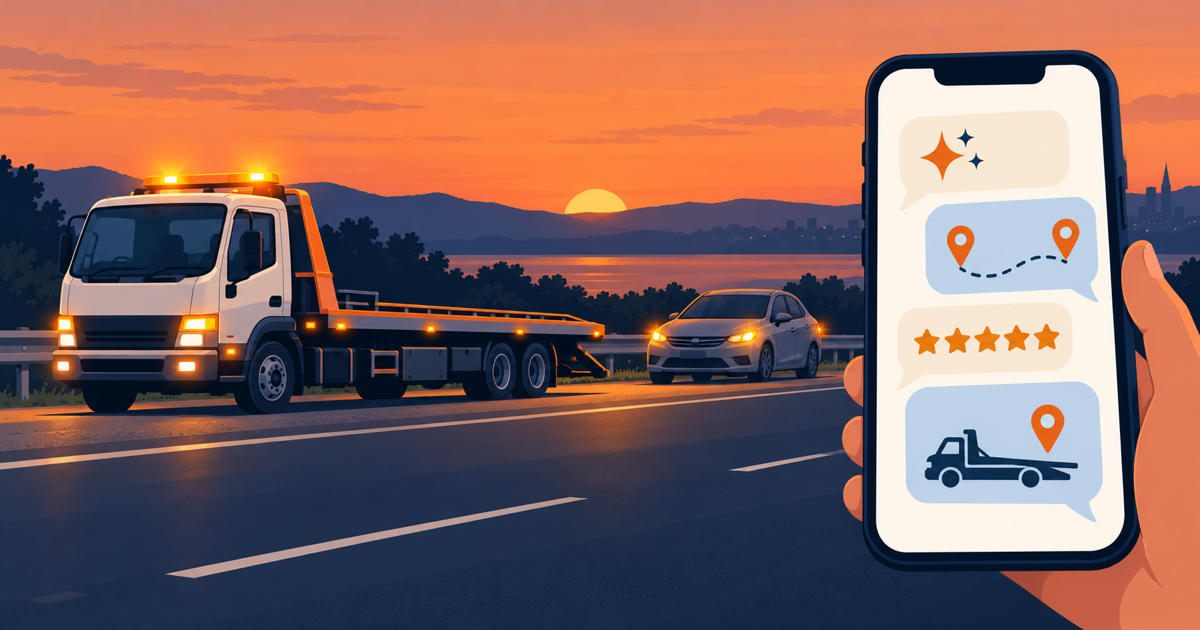
A driver is on the shoulder of the highway with hazard lights on and a phone at 20% battery. They won't scroll through ten websites. More and more of them type one question into ChatGPT or Google and call the first name that sounds open and close.
If your trucks are free and your number never comes up, that call goes to someone else. AI SEO for towing companies (search engine optimization for AI tools) is how you become one of the names those tools give. Most of it is plain groundwork you can do in a few evenings.
AI SEO for towing companies means making your tow business simple for ChatGPT, Google AI and Copilot to pick out and believe when a driver is stuck. Keep your name, number and 24-hour hours identical on every listing, publish clear rates and service towns, add AutomotiveBusiness schema, earn detailed reviews, then keep testing, since AI answers shift from one ask to the next.
Key takeaways
- Drivers ask AI about speed, vehicle type, price and trust, so your website needs a plain answer to each.
- A strong Google profile isn't enough on its own. ChatGPT pulls more from Yelp, Bing and your own site.
- schema.org has no towing type. Use AutomotiveBusiness and make it match your pages.
- A rates page and proof that you're a real, local tower answer the driver's biggest fear.
- You can be named at noon and missing at midnight. Judge your results over weeks, not one search.
What does a stranded driver ask AI before calling a tow?
A stranded driver asks AI four kinds of towing questions: who can come right now, who can move this vehicle, what it will cost, and whether the company is safe to trust. Each one needs a different answer on your website and listings.
Asking AI for a local business is now normal. BrightLocal's 2026 consumer survey found 45% of people do it with ChatGPT or a similar tool, against 6% a year earlier. That makes AI the third most used source for business recommendations, after Google and Facebook.
Here is what those questions sound like at the roadside.
| Moment | What the driver types | What AI needs to find about you |
|---|---|---|
| Right now | "Tow truck near me open now" | Real 24-hour hours, a local number, the towns and highways you cover |
| Right now | "24 hour towing on I-35 near Round Rock" | Named roads, exits and towns on your site |
| Vehicle type | "Flatbed tow for an AWD car" | A flatbed page that says which vehicles you carry |
| Vehicle type | "Who tows motorcycles near me?" | A motorcycle towing page, with photos of the right gear |
| Small fix | "Locked out of my car, who can help tonight?" | Lockout, jump start and tire change pages, with hours |
| Price | "How much does a tow cost per mile?" | Your hook-up fee, per-mile rate and after-hours charge |
| Trust | "Is [your company] a legit tow company?" | Reviews, truck photos, license or permit numbers, a real address or service area |
There is a second searcher, too. Someone whose car was towed from a parking lot types "where is my car towed in [city]?" That person needs your impound address, hours and release rules, not your roadside page.
Notice that hardly anyone types "best tow company." These are the questions your dispatcher already answers on the phone every night.
See what AI says about your business: get a free AI audit → Enter your website and we show you how AI search reads it and what to fix first.
Why can Google know your tow company while ChatGPT doesn't?
Google and ChatGPT read different sources, so a tow company can look strong in one and be missing from the other. Google's AI features draw on your Google Business Profile, while ChatGPT draws more on Yelp, Bing and your own website.
In BrightLocal's Local AI Visibility Study (September 2026), business websites were the single biggest source AI answers cited, at 42%, and Google Business Profile was hardly used by ChatGPT. The same study found service-area businesses were mentioned less often than ones with a storefront, 29.4% against 33.6%. Most towers run from a yard nobody visits, so your website has to spell out the towns and roads that a shop sign would.
Which listings should a tow company keep identical?
Your Google Business Profile, Yelp page, Bing Places entry, Apple Business card, Facebook page and BBB profile should all carry one name, one phone number, the same hours and the same towns. AI tools compare those sites with your website before they repeat any detail.
BrightLocal doesn't break out towing. Its August 2026 study of AI directory sources does measure car repair shops, the closest neighbor, so treat these shares as a guide for car repair shops, not tow companies.
| Listing | Share of car repair AI citations (2026) | Why a tower needs it |
|---|---|---|
| Google Business Profile | 53.9% | The source behind Google Maps and Google's AI answers |
| Yelp | 19.4% | A main source for ChatGPT, which can now quote Yelp reviews |
| 2.8% | Truck photos and "we're out tonight" posts during storms | |
| MapQuest | 1.7% | Small, but still cited |
| Better Business Bureau | 0.8% | Answers "is this tow company legit?" questions |
| Bing Places | Not measured | Feeds Bing and Copilot, and BrightLocal ties ChatGPT to Bing data |
| Apple Business | Not measured | Free; feeds place cards on Apple Maps, Safari and Spotlight |
Under a new licensing deal with OpenAI, ChatGPT answers can now show Yelp ratings, photos and reviews, MarTech reported in July 2026. On the iPhone side, Apple Business took over from Apple Business Connect in April 2026, at no cost.
Mismatches are common. SOCi's 2026 Local Visibility Index (summarized by BrightLocal) reported that just 68% of the contact details ChatGPT and one other AI chat tool showed lined up with each business's Google Business Profile. For a tow company, a wrong number at 2 a.m. is a lost job.
Check each listing against this list:
- Your business name exactly as it is painted on the truck door. No "24 Hour Cheap Towing Dallas" in the name, which Google's guidelines don't allow.
- One local phone number everywhere. Google asks for a local number over a central call center line when you can.
- "Open 24 hours" only if a person really answers at 3 a.m.
- Your towns and highways listed by name.
- Every tow type you offer: flatbed, wheel-lift, motorcycle, heavy duty, lockout, jump start.
- A good set of photos of your own branded trucks.
Pro tip: if you run a dispatch service after hours, make sure it answers with your business name. A driver who hears a different name may hang up.
For a listing-by-listing claiming walkthrough, see which ChatGPT local business listings to claim.
What schema type fits a towing company?
A towing company should use the AutomotiveBusiness schema type, because schema.org has no towing-specific type. Schema is a few lines of hidden code that spell out facts such as your phone number and opening hours, so software doesn't have to guess them.
On schema.org, AutomotiveBusiness sits under LocalBusiness. Its narrower types are for repair shops, body shops, dealers, car washes and the like. If you also run a repair bay, you can add AutoRepair as a second type.
Here is a trimmed example for a 24-hour tow company. Whoever looks after your website can add it and change the details to yours.
{
  "@context": "https://schema.org",
  "@type": "AutomotiveBusiness",
  "name": "Example Towing & Recovery",
  "url": "https://www.example.com",
  "telephone": "+1-512-555-0100",
  "areaServed": ["Round Rock, TX", "Georgetown, TX", "Pflugerville, TX"],
  "openingHoursSpecification": [{
    "@type": "OpeningHoursSpecification",
    "dayOfWeek": ["Monday", "Tuesday", "Wednesday", "Thursday", "Friday", "Saturday", "Sunday"],
    "opens": "00:00",
    "closes": "23:59"
  }],
  "makesOffer": [
    {"@type": "Offer", "itemOffered": {"@type": "Service", "name": "Flatbed towing"}},
    {"@type": "Offer", "itemOffered": {"@type": "Service", "name": "Motorcycle towing"}},
    {"@type": "Offer", "itemOffered": {"@type": "Service", "name": "Lockout service"}}
  ],
  "sameAs": [
    "https://www.yelp.com/biz/example-towing-and-recovery",
    "https://www.facebook.com/exampletowing"
  ]
}
If drivers come to your yard to collect cars, add an address block with the yard's street address. If you are service-area only and your Google profile hides your address, leave it out so the code and the profile agree.
Keep expectations level. Google is clear that AI Overviews and AI Mode need no special markup, and its guidance wants structured data to agree with the words visitors see.
The code only repeats what your pages say, in a format machines like. If it says 24 hours and your contact page says "closed Sundays," you've told AI two different stories.
New to the idea? This beginner's schema markup guide explains how to spot whether your site already has some.
Put your rates and your proof where AI can read them
Your rates and your proof of being a real, local tower belong on your own website, in plain words. Drivers worry about being overcharged at the roadside, and a page that answers that worry gives AI something clear to quote.
That worry is real. NJM Insurance tells drivers to call a reputable towing service, ask to see a printed list of towing and storage costs, photograph the truck's signage and plate, and ask for a business card. Every one of those checks can start on your website.
Build two pages most tow companies skip.
- Rates page. Your hook-up fee, per-mile rate, after-hours charge, storage rate per day and the payment types you take. Use your own real numbers. If prices vary, give a range and say what changes it.
- About and proof page. Your license or permit numbers if your state or city issues them, your insurance, years in business, your yard address if customers pick up cars there, and photos of branded trucks.
Next, write a few short Q&A blocks that each make sense alone, since an AI tool may lift a single paragraph. Adapt these:
Are you open right now? Yes. [Company] answers calls 24 hours a day, 7 days a week, in [towns]. Most calls in [main town] get a truck in about [time you can keep]. Call [phone].
How much does a tow cost? A local tow with [Company] starts with a [amount] hook-up fee, then [amount] per mile. Nights and weekends add [amount]. We tell you the total before we hook up your vehicle.
Fill in your real details. Never post a response time your drivers can't hit on a busy Friday night, because a review will say so.
Last, check the door is open. The bots that AI search tools send to read websites follow a small text file on your site called robots.txt. OpenAI's crawler page names OAI-SearchBot as the bot behind ChatGPT search, suggests letting it in through robots.txt, and warns an update needs roughly 24 hours to kick in.
Give every town and every tow type a page of its own
Every town you regularly cover, and every type of tow you offer, should have its own page with real local detail. These pages help make up for the storefront gap and match the exact way drivers phrase their questions.
Start with your Google profile. Under Google's Business Profile rules, a tower whose customers never visit the yard should keep that address hidden. Your service area shouldn't stretch farther than about 2 hours of driving from your base. If drivers come to your yard to collect cars, that is a different setup, so check the rules before you choose.
A good town page covers:
- The town's name up top and in the opening sentence.
- The highways, exits and main roads you work.
- A response time you can actually keep there.
- Where you take vehicles: your yard, a named repair shop, or the driver's choice.
- One or two recent jobs and reviews from that town.
Then give each service its own page: flatbed, motorcycle, heavy duty, winch-out, lockout and jump start. A driver who asks "who tows box trucks near me?" needs a page that says you do.
Keep impound and private-property towing on a separate page. Put your yard address, release hours, what ID to bring and how to pay. It helps the angry driver find their car, and it keeps that traffic off your roadside pages.
Say you run four trucks covering six towns. Six honest town pages and six service pages beat fifty cloned pages where only the place name changes. Drivers notice the difference, and so do AI tools.
Roofers face the same no-storefront problem, and our AI SEO guide for roofers shows how a trade with storm surges handles town pages. For the wider picture, read about service area business AI search.
Want it done for you? Get your AI SEO setup for $349 → We add the code AI reads, fix AI crawler access and your business info. Done in 48 hours, with a 30-day money-back guarantee.
How do towing companies get reviews that help in AI answers?
Towing companies get useful reviews by asking every customer the same day, by text, and letting them describe the job in their own words. Aim for at least 20 reviews and a steady trickle of new ones each month.
The BrightLocal Local Consumer Review Survey 2026 explains why those two targets matter:
- 47% of shoppers rule out any business with under 20 reviews.
- 74% want to see reviews from the past three months.
Detail is what most tow reviews lack. "Fast and friendly" tells an AI tool little. "Came out to Highway 79 at 1 a.m. and flatbedded my Subaru to the dealer" tells it the road, the hour, the vehicle and the service.
Here is a text your driver or dispatcher can send after the drop-off:
Hi [name], thanks for calling [Company] tonight. Hope the rest of your trip goes easier. Got a minute? A quick review helps other drivers in [town] find us. Here's the link: [review link]
Answer each review by first name and mention the tow. For a bad one, keep your cool, admit any slip, and offer a direct line to put it right.
Don't pay for reviews or ask only the customers you know were happy; Google's review policy bans both. Yelp goes further: it tells businesses not to ask for reviews at all and can hide ones that look prompted. Point your review texts at Google and leave Yelp alone.
Pro tip: print the review link as a QR code on the receipt your driver hands over. The best moment to ask is when the car is safely off the truck.
How do you test AI answers like a driver at 2 a.m.?
Test AI answers by typing the same roadside questions a stranded driver would, at the hours they would, and noting whether your company is named. Repeat each one on different days, because a single answer proves very little.
BrightLocal found that when the same ChatGPT local search was run again, the answers were on average only 23% alike. Being named on Monday and gone on Tuesday is part of how these tools work.
For a tow company, add these to your test list:
- Late-night asks. Run some tests after 10 p.m., when "open now" really bites and day-only shops should drop out.
- "Open now" and "24 hour" phrasing. Pair each with a town or highway exit you cover.
- Vehicle questions. Flatbed, motorcycle and box truck, one each.
- The impound question. "Where is my car towed in [city]?" should lead to your release page, not a competitor's.
- Copilot as well as ChatGPT and Google. Copilot draws on Bing, so it is your check on Bing Places.
Keep a simple sheet with the question, the date, the tool and every company named. For the full testing method, including how many runs to do and how to read the results, use our guide to testing ChatGPT fairly.
Where should AI SEO for towing companies start?
Fix listings first, website pages second, schema and crawler access third, and reviews last. Listings come first because a phone number that differs from site to site makes every other fix less useful.
Here is a four-week plan:
- Week 1: Get every listing (Google, Yelp, Bing Places, Apple Business, Facebook, BBB) showing one name, one number, the same hours and the same towns.
- Week 2: Publish your rates page, proof page, and the open-now and price answer blocks.
- Week 3: Add town and tow-type pages, AutomotiveBusiness schema, and make sure robots.txt welcomes AI crawlers.
- Week 4: Text a review request to recent customers who agreed to be contacted, then run your first late-night test.
There are three realistic routes:
| Option | What it involves | Good fit if |
|---|---|---|
| Do it yourself | Work through the four weeks yourself | You like a project and have quiet evenings between calls |
| Monthly agency | You pay monthly for continuing work and updates | You run a big fleet and want new content every month |
| Done-for-you setup | A one-off technical setup by someone else | You'd rather keep your trucks on the road |
Want the third route? Our done-for-you AI SEO setup costs $349 once (normally $497), with no monthly fee. We look at what ChatGPT, Claude, Google AI and Copilot say about your tow company, add the schema code, open up AI crawler access, and line up your name, address, phone and hours across the web. The work takes 48 hours, and a 30-day money-back guarantee covers it. It won't write your rates page or gather reviews, and no one can promise an AI tool will pick your company.
Frequently asked questions
Should a tow company list itself as open 24 hours?
Only if a person answers the phone at every hour. Set "Open 24 hours" on Google, Yelp, Bing and Apple, and say the same on your website and in your schema. If nights go to voicemail, list your real hours and add an after-hours note instead.
Do motor club jobs help a towing company in AI search?
Motor club jobs usually don't put your name on the driver's screen, because the club handles the dispatch. They can still lead to reviews if you ask politely after the job. Your own listings and website are what AI tools read to name you directly.
Is ChatGPT showing my old phone number?
ChatGPT may be reading an old Yelp or Bing listing, or an old directory page. Fix the number on every listing first, then on your website. Our guide to fixing wrong business information in ChatGPT covers the full steps.
Does a tow company need a website if it has a Google profile?
Yes. Business websites were the biggest single source AI answers cited in BrightLocal's 2026 study, and ChatGPT hardly uses Google Business Profile. A plain site with your towns, tow types, rates and hours gives ChatGPT something to read.
The short version
AI SEO for towing companies comes down to being easy to check at the roadside. Keep the same name, local number and real hours on every listing. Put your towns, tow types, rates and proof on your own website, label it with AutomotiveBusiness schema, and ask for detailed reviews after each job.
Then ask the questions drivers really ask, late at night as well as by day, and keep a log. One answer is a snapshot; a month of answers is a picture.
Ready to see what AI says about your tow company today?
Want to see where you stand first? Get a free AI audit. Ready to have it done for you? Get your AI SEO setup for $349, done in 48 hours.
Related Reading
- AI SEO for Roofers: Help AI Find You When the Storm Hits: AI SEO for roofers: the storm, insurance and price questions homeowners ask,…
- ChatGPT Wrong Business Information? Fix Your Hours and Phone: ChatGPT wrong business information, like old hours or a dead phone number?…
- How Does ChatGPT Recommend Local Businesses? The 2026 Data: How does ChatGPT recommend local businesses? BrightLocal's 2026 data shows…
- Service Area Business AI Search: Show Up Without a Storefront: Service area business AI search, made plain: why trades with no storefront…
- AI SEO setup for $349 →: We get your website ready for ChatGPT, Claude, Google AI and Copilot. Done in 48 hours.