AI SEO for Home Builders: What Buyers Ask AI Before They Call
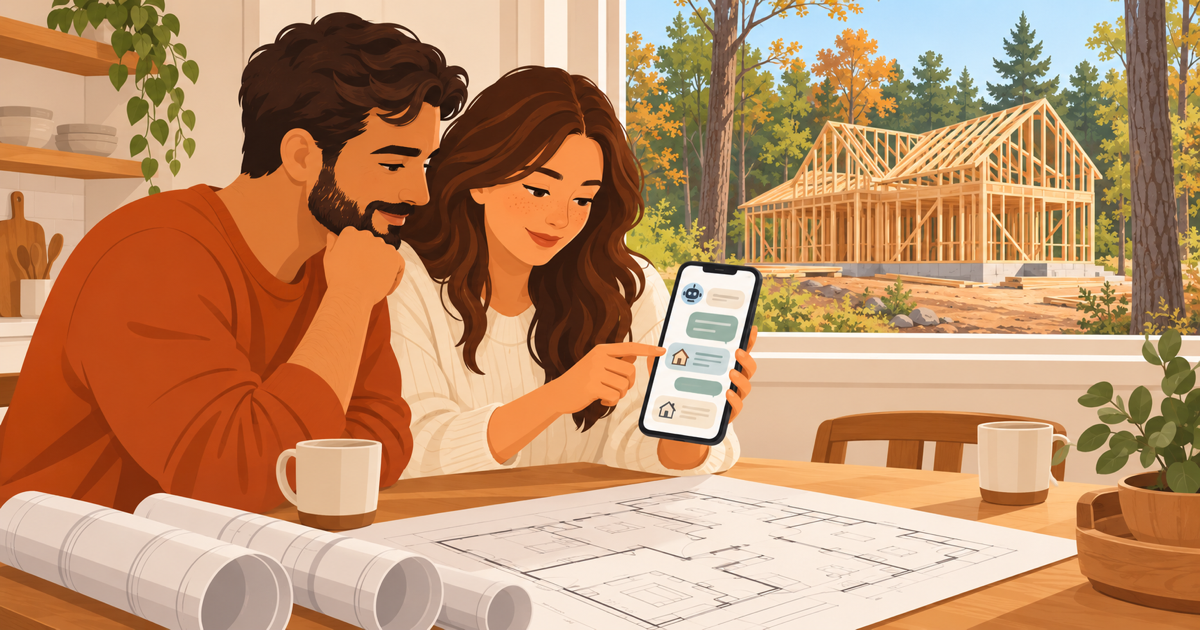
Picture a couple who bought an acre last spring and want to build on it. Before they ever call you, they may ask an AI tool dozens of questions about lots, budgets, timelines and builders. AI SEO for home builders is the work of making sure those answers can include you, with the right facts.
A home builder gets mentioned in AI answers when the same clear facts show up in many places: the counties you build in, the homes you build, a price range, a typical timeline and real reviews. Put them on your website, your listings and in schema code. Nobody can force a mention, and answers change between runs.
Key takeaways
- Future homeowners ask AI questions for months before they call, about land, cost, timing and which builders to trust.
- People with a referral still ask AI to check you out, so your facts need to match everywhere.
- A written project page for each finished home gives AI something to quote. A photo gallery alone does not.
- GeneralContractor is the closest schema.org type for a home builder.
- Ask AI about your company the way a referred couple would, three times over, before you decide what it thinks of you.
What do future homeowners ask AI before they call a builder?
Future homeowners ask AI a long chain of questions over many months: what land needs, what a custom home costs per square foot, how long it takes, and which local builders are any good. Few of those questions are "open now" or emergency searches. They are slow, careful research questions, and each one needs a fact from you.
The habit is now normal. In BrightLocal's Local Consumer Review Survey 2026, use of ChatGPT and other AI tools for local recommendations rose from 6% in 2025 to 45% in 2026. Among people shopping for a home, 45% of prospective homebuyers said they had used AI tools in their search, up from 37% a year earlier, in the Veterans United Q2 2026 homebuying survey.
A custom build gives people plenty of time to ask. According to NAHB's review of 2025 Census data, homes built by hired contractors took about 11.7 months from permit to completion, against 7.4 months for homes built for sale. Owner-built homes, which NAHB counts as part of custom building, took 14.3 months. Add the months of planning before the permit, and that is a long time to be asking questions.
Here is what those questions look like across the journey, with Asheville, North Carolina standing in for your area.
| Stage | What they type into ChatGPT or Google | What AI needs from your business |
|---|---|---|
| Dreaming | "Custom home builders near Asheville that build modern farmhouses" | Home styles you build, shown on real project pages |
| Land | "Builders in Buncombe County who build on your lot" | A clear "we build on your land" page, by county |
| Land | "What does it cost to build on a sloped lot near Asheville?" | Plain answers on site work, slopes, wells and septic |
| Budget | "Cost per square foot for a custom home in western North Carolina" | A published range and what it includes |
| Timeline | "How long does a custom home take to build?" | Your typical months, and what stretches them |
| Vetting | "Is [your company] a good builder? Any complaints?" | Reviews, years building, license number, how you handle delays |
| After move-in | "Who do I call about a warranty issue with my new home?" | A warranty page with a phone number and real hours |
Notice that few of these say "best builder."
See what AI says about your business: get a free AI audit → Enter your website and we show you how AI search reads it and what to fix first.
Why does a referral still end up in a ChatGPT chat?
People with a referral still ask AI about a builder because it is a quick, private second opinion before a big decision. The question shifts from "who builds near me?" to "is this builder any good?", and AI answers it from whatever it can find about you.
Referrals still bring in most custom work. According to the Houzz Pro State of the Industry 2026 report, quoted in Custom Builder, 83% of home pros on Houzz say referrals contribute meaningfully to their revenue. The same article cites Houzz's 2026 AI report: nearly one in 10 homeowners already use AI to find, evaluate and communicate with pros.
The shortlist is short, too. BrightLocal's Local AI Visibility Study, published September 16, 2026, found ChatGPT named 4.1 businesses per local answer on average. A couple comparing their friend's builder against three or four others will judge you on whatever facts AI has in hand.
What should a home builder's project page say?
A home builder's project page should say where the home is, what lot it sits on, its size and style, how long it took, and the hard problem you solved, in words as well as photos. A project page is a page on your website about one finished home, and it is the single best thing a custom builder can add for AI search, because it proves what you build, where and how.
Your website matters more than any one listing. In BrightLocal's 2026 Local AI Visibility Study, business websites made up 42% of the sources AI tools cited for local businesses.
A gallery of 40 photos captioned "Lakeside Residence" tells AI almost nothing. A few short paragraphs about the same house tell it the town, the lot, the style, the size, the timeline and the problem you solved.
Use this template for each home. Fill in the brackets and keep it honest.
[Home name], [town], [county] A [number]-square-foot [style] home on a [lot type, e.g. wooded 2-acre sloped lot] the owners already owned. Design took [months] and construction took [months] from permit to move-in. The hard part: [one real challenge, e.g. a steep driveway, a well, a tight HOA review]. We handled it by [what you did]. Built with [two or three materials or systems the owners chose]. Budget band: [your range, or "under / over" a figure you are comfortable sharing]. What the owners said: [link to their review on Google or Houzz].
Say you finished a mountain home last fall. A page that says "four-bedroom timber-frame home on a sloped lot in Weaverville, 13 months from permit to keys, with a new well and a septic system" answers three of the questions in the table above in one breath.
Pro tip: start with your last three finished homes, not all thirty. Three detailed pages beat thirty photo albums.
Publish a price range buyers can plan around
A custom home builder should publish an honest price range and say what it includes. AI tools cannot repeat a number you never wrote down, so a builder with no prices online tends to be left out of cost questions, or described with someone else's guess.
You don't need a single number, since custom work swings too much for that. Buyers want a starting point and the reasons it moves.
Explain the things that change the price in plain words:
- The lot. Clearing, grading, driveways, retaining walls, wells and septic can add a lot before the foundation goes in.
- Allowances. An allowance is the budget set aside for things the owner picks later, like cabinets, tile and lighting. Say how you set them.
- What "per square foot" covers. Say if your range includes site work, permits and design fees, or not.
Then write a short answer block that makes sense on its own, because AI may quote only that block.
How much does a custom home cost with [Company]? Most of our custom homes in [counties] land between [your low] and [your high] per heated square foot, not including the lot. Site work on sloped or wooded land is priced after a site visit. We share a line-by-line estimate before you sign anything.
Do the same for time. "Most of our homes take [months] from permit to move-in. Weather, custom orders and inspections can add [weeks]." Clear numbers leave AI less room to fill the gap with a national average.
What if you build in communities, not on the buyer's lot?
Home builders who sell plans in communities need one page per community and one page per floor plan, each with a price, what is included, and what is available now. Buyers ask AI about a neighborhood and a plan by name, so each one needs its own page with plain-text facts.
Production and semi-custom builders face a different risk than custom builders: stale numbers. A price that changed in March can live on in an old brochure, a listing site and a sales sign, and AI may repeat whichever one it finds. A sponsored HousingWire piece on AI and the new-home search gives the same advice: "Keep critical facts synced across sites, listings, signage, and sales tools."
If AI already shows an old price or phone number, here's how to fix wrong business information in ChatGPT.
A useful community setup looks like this:
- A community page with the town, school district, lot sizes, HOA fees and the plans built there.
- A page per floor plan with square footage, bedrooms, the base price and what "base" includes, written as text, not only inside a PDF or image.
- A quick move-in homes list that is updated the day a home goes under contract.
- One set of numbers on your site, your signs and any new-home listing sites you feed.
If you only build a few spec homes a year, a single "available homes" page that you keep current does the same job.
Where should a home builder be listed besides Google?
A home builder should be listed on Google Business Profile, Houzz, Yelp, Bing Places, Apple Business (formerly Apple Business Connect) and Facebook, with the same name, phone and service area on each. Then check the two places careful buyers go to vet a builder: your state's contractor license lookup and your local home builders association.
The table below is for builders, not trades in general. It covers what buyers look for on each site, so you know what to keep current.
| Listing | Who it matters most for | What buyers check there | What to keep matching |
|---|---|---|---|
| Google Business Profile | Every builder | Reviews, photos, service area, hours | Name, phone, office address or service area |
| Houzz | Custom and design-led builders | Project albums, reviews, style | Project names and towns that match your site |
| Yelp, Bing Places and Apple Business | Every builder | Basic facts and reviews | Name, phone, hours |
| State contractor license lookup | Every builder | That your license is active, and its exact business name | The legal name you use in schema and on contracts |
| Local home builders association | Builders who are members | Membership and good standing | Company name and website |
| New-home listing sites | Community and spec builders | Plans, prices, available homes | Prices and availability, updated with your site |
| Every builder | Progress photos, recent activity | Name, phone, website link |
Yelp and Bing deserve more care than they usually get. The BrightLocal visibility study found ChatGPT rarely uses Google Business Profile and leans on Yelp and Bing for local business details, so a builder who only polishes Google can be missing where ChatGPT looks.
The license lookup and the home builders association matter because of the vetting question. NAHB says more than 600 state and local home builders associations make up its federation. If yours lists members publicly, make sure your entry uses the same name and website as everything else.
For the general listings, our guide to the listings ChatGPT pulls from and how to claim them covers Yelp, Bing Places and Apple Business.
Is GeneralContractor the right schema type for a home builder?
Yes, GeneralContractor is the closest schema.org type for a custom home builder. Schema is a short block of code on your website that labels your facts (name, phone, service area, listings) so software reads them without guessing.
On schema.org, GeneralContractor sits under LocalBusiness and HomeAndConstructionBusiness. If you also do a lot of remodeling, the parent type HomeAndConstructionBusiness is a fair choice too. Either one supports areaServed for the counties you build in and sameAs for links to your Houzz, Yelp and other profiles.
Here is a trimmed example your web person can adapt.
{
  "@context": "https://schema.org",
  "@type": "GeneralContractor",
  "@id": "https://www.example.com/#builder",
  "name": "Example Custom Homes",
  "url": "https://www.example.com",
  "logo": "https://www.example.com/logo.png",
  "image": "https://www.example.com/projects/weaverville-timber-frame.jpg",
  "telephone": "+1-828-555-0100",
  "description": "Custom homes on your lot in Buncombe, Henderson and Madison counties.",
  "address": {
    "@type": "PostalAddress",
    "streetAddress": "100 Example Street",
    "addressLocality": "Asheville",
    "addressRegion": "NC",
    "postalCode": "28801"
  },
  "areaServed": [
    { "@type": "AdministrativeArea", "name": "Buncombe County, NC" },
    { "@type": "AdministrativeArea", "name": "Henderson County, NC" },
    { "@type": "AdministrativeArea", "name": "Madison County, NC" }
  ],
  "sameAs": [
    "https://www.houzz.com/professionals/example-custom-homes",
    "https://www.yelp.com/biz/example-custom-homes",
    "https://www.facebook.com/examplecustomhomes"
  ]
}
The address block is for a builder with a staffed design office that clients visit, and it should match your Google Business Profile exactly. If you work from home and hide your address on Google, leave the address out of your schema too.
Keep expectations honest. Google says "There's also no special schema.org structured data that you need to add" to appear in AI Overviews or AI Mode. It also says your structured data should match the visible text on the page. Schema is a clean label for facts that are already on your site, not a shortcut. Our guide to schema markup for small businesses shows how to check what your site has today.
Also check that AI tools are allowed to read your site. OpenAI says its OAI-SearchBot crawler is used to surface websites in ChatGPT search, and recommends allowing it in your robots.txt file (a small file that tells crawlers which pages they may read). Some sites block it by accident, so ask your web person to check.
At 30 Second Productions, our done-for-you setup is $349 one-time (normally $497), with no subscription, for owners who would rather not touch code. We check how ChatGPT, Claude, Google AI and Copilot describe your business, add the schema, fix crawler access and make your business details match.
Want it done for you? Get your AI SEO setup for $349 → We add the code AI reads, fix AI crawler access and your business info. Done in 48 hours, with a 30-day money-back guarantee.
Does a home builder need a page for each county?
Yes, a home builder should have a page for each county or town where it regularly builds and pulls permits, with details only a local builder would know. County pages tell AI where you work without relying on a storefront address.
Many builders sit in between a shop and a service business: an office or design studio where clients meet, and job sites spread across a wide area.
Google's Business Profile guidelines cover both cases. If clients visit a staffed office during set hours, you can show that address and add a service area. If you work from home, hide the address. Either way, Google says your service area shouldn't extend farther than about 2 hours of driving from your base. Our Google Business Profile guide for contractors covers the rest of the setup.
A useful county page includes:
- The county name in the heading and the first sentence.
- Homes you have built there, linked to their project pages.
- Local lot facts: slopes, well or city water, septic or sewer, flood zones.
- How permits work there, and roughly how long they take.
- HOAs or design review boards you have worked with.
That list is hard to fake, which is the point. For more on pages like these, see our guide to getting found in AI search without a storefront.
When should a builder ask a homeowner for a review?
A builder should ask for a review twice: in the first week after handover, and again after your end-of-first-year warranty walk (often at month 11). The first catches the joy of move-in day. The second shows how you treat owners once the check has cleared, which is what careful buyers want to know.
A builder finishes fewer jobs than a plumber, so each review carries more weight. Here is a message you can send:
"Thanks again for trusting us with your home. If you have five minutes, a Google review would mean a lot. It helps future owners if you mention the town, the kind of home we built, and how the schedule and budget went. Here's the link: [review link]"
Reply to every review, including the one about the three-week delay. A calm, specific reply ("the window order slipped, and here's what we changed") tells the next buyer, and the AI tool reading the page, how you handle problems.
How can you check what ChatGPT says about your building company?
You can check what ChatGPT says about your building company by asking the questions a referred couple would ask, then a stranger's questions, and repeating each one. A single answer can mislead you: BrightLocal's 2026 Local AI Visibility Study found two runs of the same ChatGPT local search overlapped by only 23%. Our article on why ChatGPT recommendations change explains why, and our guide on how to check if ChatGPT recommends your competitors goes further.
Step 1: Ask the referred couple's questions first
Start with your name: "Is [Company] a good builder?", "Does [Company] go over budget?" and "How long has [Company] been building in [county]?" These show whether AI has your facts right before you worry about being found.
Step 2: Ask the stranger's questions
Pick a few open questions from the table near the top, using your real towns and counties, such as "builders in Henderson County who build on your lot."
Step 3: Run each one three times in ChatGPT, Claude, Google AI and Copilot
Use a fresh, private chat each time so your own history doesn't skew the answers. Each tool reads different sources, so a gap in one points to the listing or page to fix.
Step 4: Log what you see, fix the source, and repeat next month
A simple grid is enough. Here is what two rows might look like:
| Question | Tool | Named you (out of 3) | Facts right? | Source cited |
|---|---|---|---|---|
| "Custom builders in Buncombe County who build on your lot" | ChatGPT | [0-3] | [phone, counties, price] | [e.g. Yelp, your site] |
| "Is [Company] a good builder?" | Google AI | [0-3] | [years, reviews, license] | [e.g. Houzz, Google reviews] |
If AI quotes an old Houzz album or Yelp page, fix that page. If it gets your price wrong, check your own pricing page first.
What will AI SEO for home builders not fix?
AI SEO for home builders makes your facts easy to find and check. It will not fix slow replies to inquiries, a string of bad reviews or a website with no finished homes on it.
It also won't make AI name you on demand. No one can promise that ChatGPT or Google AI will put your company on a couple's shortlist, any more than you can promise a lot will pass a perc test before it's dug. What the work does is remove the reasons AI might skip you: missing facts, blocked crawlers, mismatched listings and code that labels nothing.
Frequently asked questions
How do I get my home building company recommended by ChatGPT?
No one can guarantee ChatGPT will recommend a builder, and its answers change from run to run. You can give it fewer reasons to skip you: write project pages and county pages on your site, keep Yelp, Bing Places, Houzz and Google identical, and earn reviews that mention the town and the home.
Does Houzz help a builder show up in AI search?
Houzz can help, mostly as a second portfolio AI can read and buyers use to check you out. BrightLocal's 2026 AI directory study found Houzz in 0.7% of AI citations for service businesses, well behind Google and Yelp. Keep your Houzz project names and towns the same as on your own site.
Do custom home builders need Angi or HomeAdvisor for AI search?
No, they are optional. BrightLocal's August 2026 AI directory study found Angi in 1.4% and HomeAdvisor in 0.5% of AI citations for service businesses, against 45% for Google and 12.3% for Yelp. Join them only if you want their leads and can keep every detail current.
Do I need a separate page for every community or plan?
Yes, if you sell plans in communities. Buyers ask AI about a neighborhood or plan by name, and one page per community and per plan gives AI a clear fact to quote. A custom builder needs the same idea, applied to finished homes and counties instead.
Does AI SEO replace referrals for a custom builder?
No. In the Houzz Pro State of the Industry 2026 report, 83% of home pros on Houzz said referrals contribute meaningfully to their revenue. AI search mostly adds a checking step, because referred buyers ask AI about a builder before they call. Clear, matching facts help protect the referrals a builder already earns.
The short version
Custom home buyers research for months, and more of that research now happens in ChatGPT, Google AI and Copilot. Some are strangers looking for a builder. Others already have your name from a friend and want a second opinion.
Give AI the facts it needs to answer both. Write a page for each finished home, and publish an honest price range and a typical timeline. If you build in communities, keep every plan page and price current.
Keep Google, Houzz, Yelp, Bing Places and your license record matching. Use GeneralContractor schema that matches your pages. Ask for reviews at handover and after the warranty walk.
AI SEO for home builders won't guarantee a mention. It does help AI get your facts right when it talks about you.
Start with the free audit to see where you stand, or let us do the setup for you.
Want to see where you stand first? Get a free AI audit. Ready to have it done for you? Get your AI SEO setup for $349, done in 48 hours.
Related Reading
- AI SEO for Med Spas: What ChatGPT Reads Before It Names a Clinic: AI SEO for med spas: what clients ask ChatGPT, the listings and schema AI…
- AI SEO for Optometrists: Plans, Hours and Schema AI Reads: AI SEO for optometrists: what patients ask ChatGPT, how to show your vision…
- AI SEO for Dentists: One New Patient Pays for This 16 Times Over: Learn how dentists get recommended by ChatGPT and Google AI. One new patient…
- AI SEO for Cleaning Companies: Get Named When Homeowners Ask AI: AI SEO for cleaning companies in plain English: the questions homeowners ask…
- AI SEO setup for $349 →: We get your website ready for ChatGPT, Claude, Google AI and Copilot. Done in 48 hours.